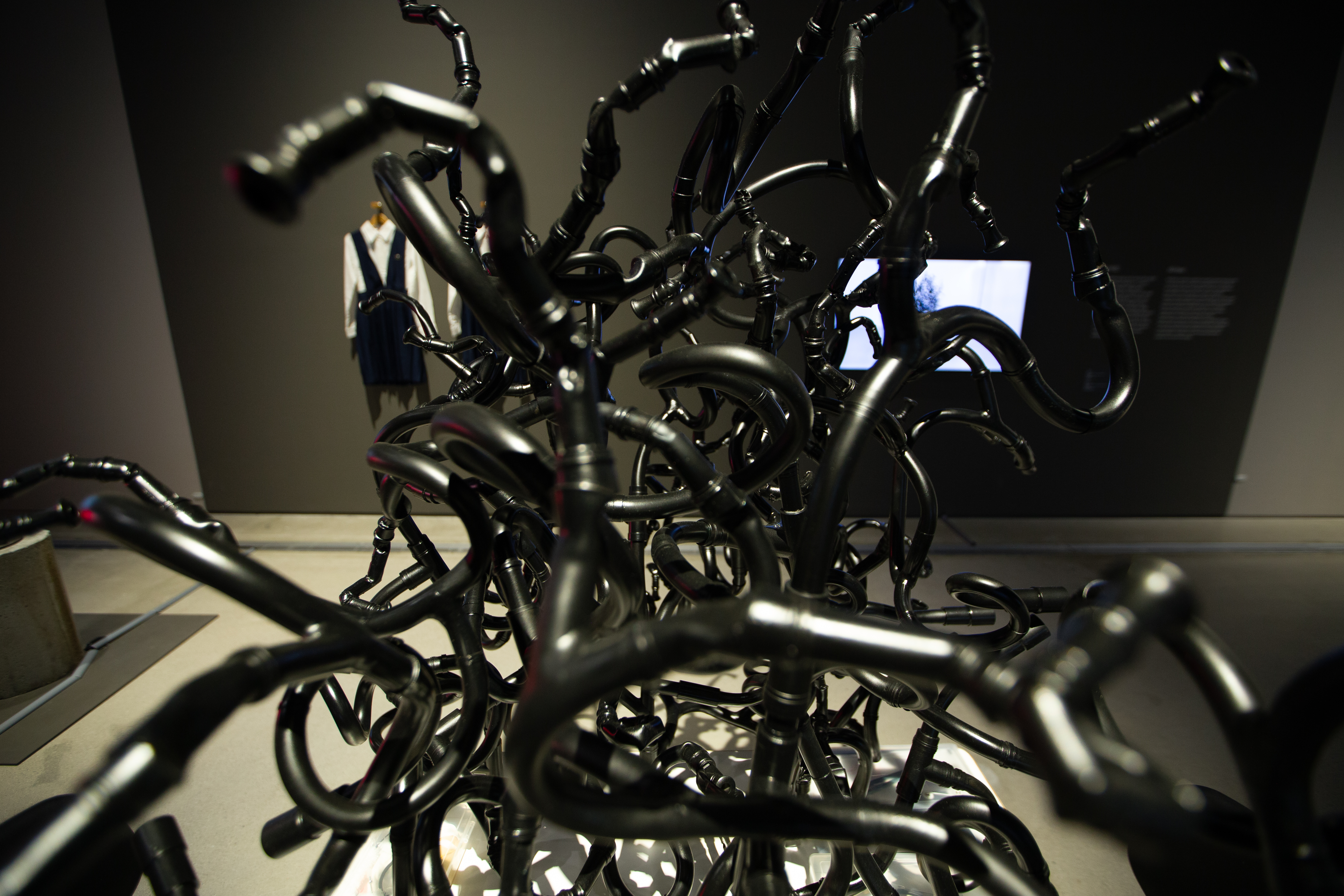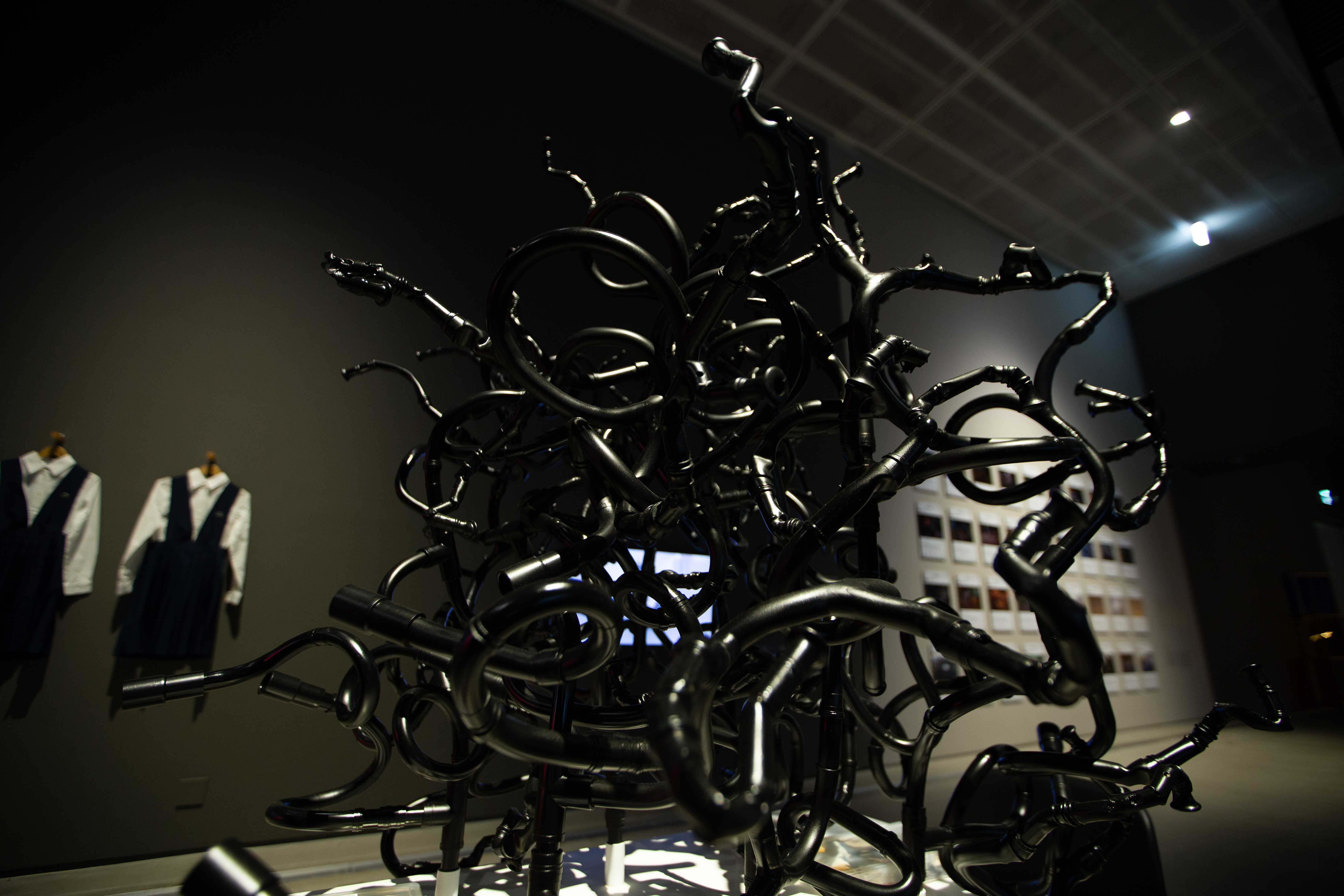
Structure Study I結構研究 I
2012, sculpture remade 2019 and completed for MMCA in 2020
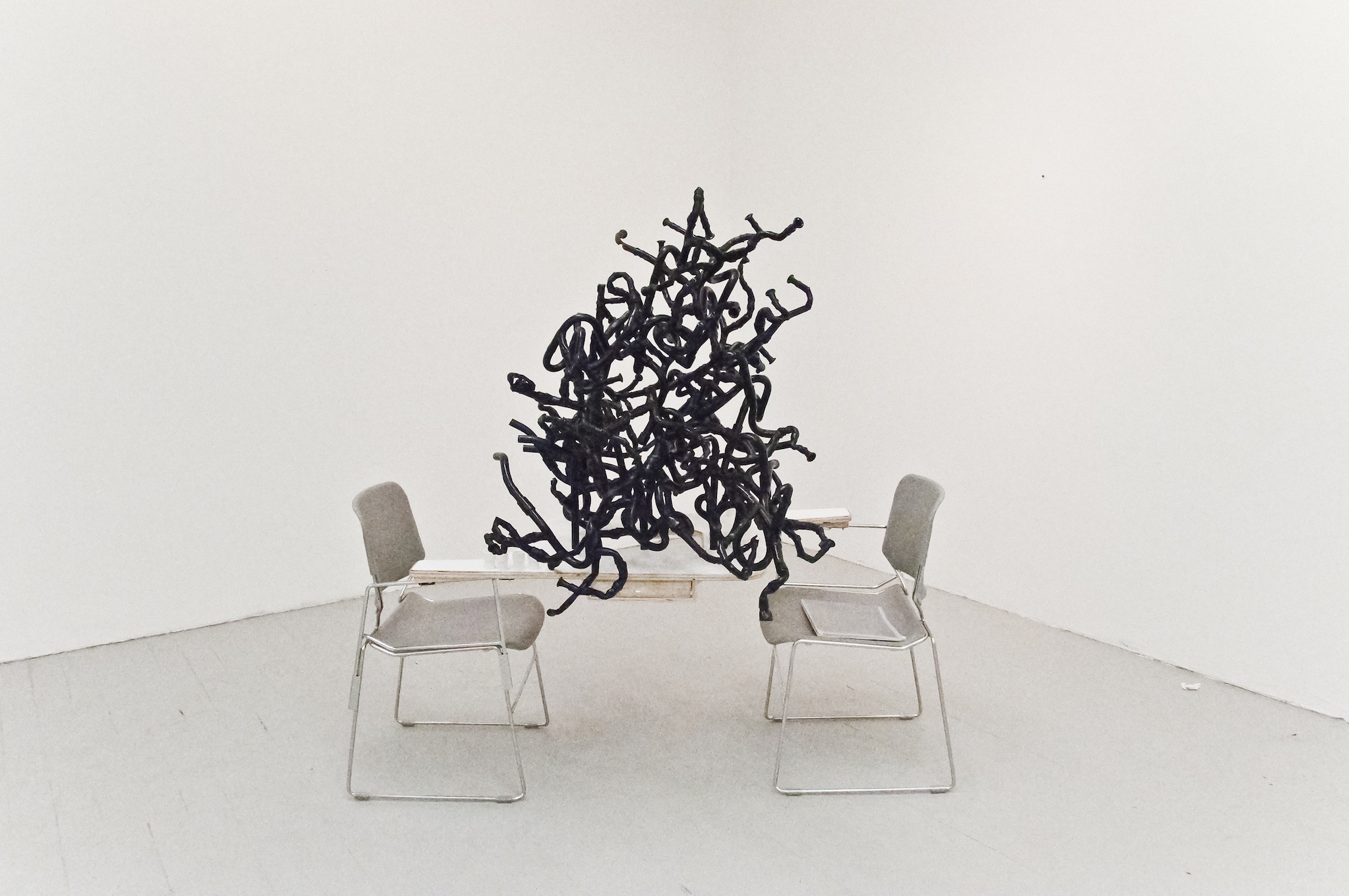
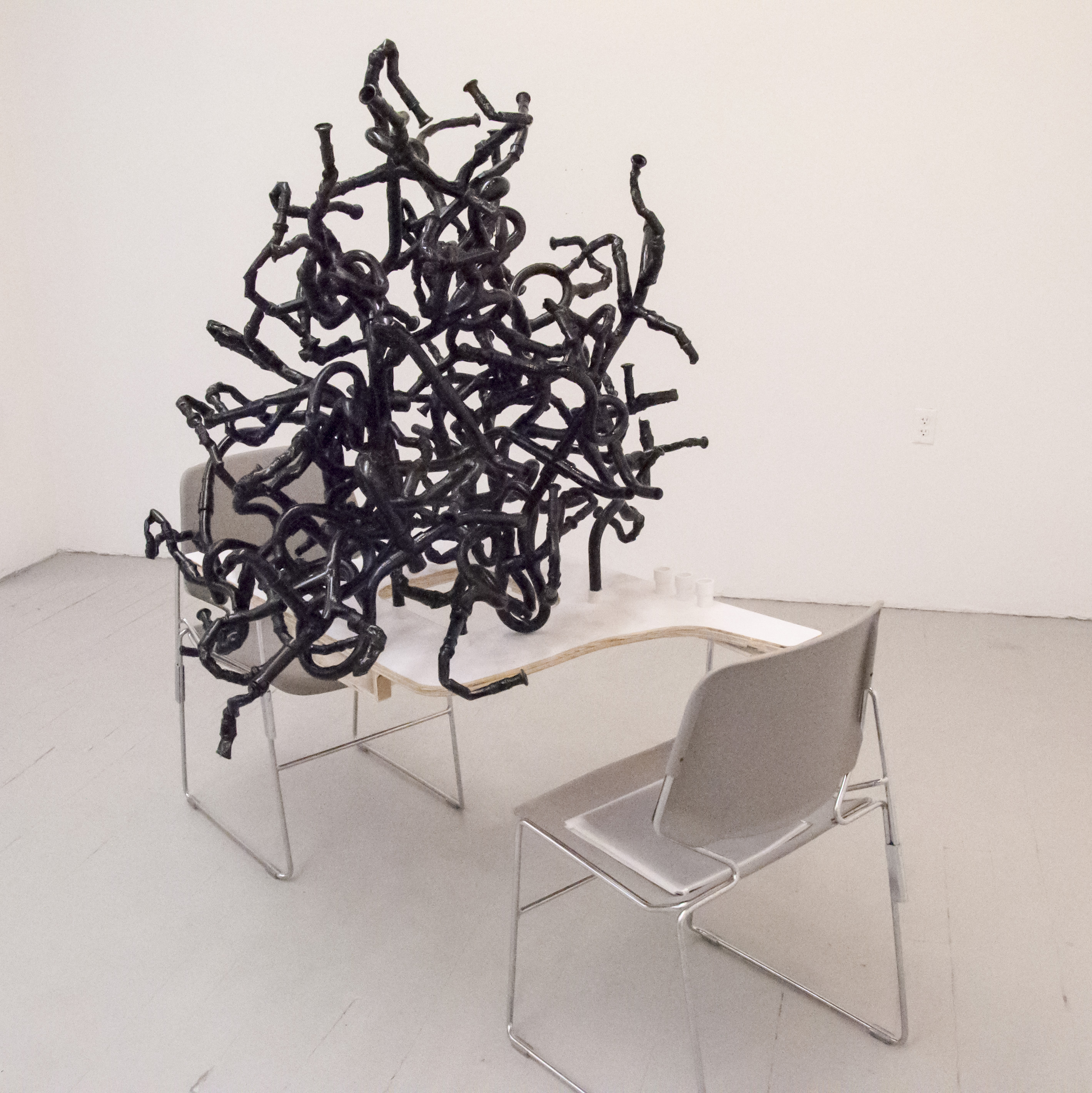
Enamel paint on PVC pipes and ABS plastic, on found chairs
Sculpture approximately 183 × 137 × 167.5 cm
Collection of the National Museum of Modern and Contemporary Art, Korea2012 年,雕塑於 2019 年重製,2020 年為韓國國立現代美術館完成
瓷漆、PVC 管、ABS 塑膠與現成椅子
雕塑約 183 × 137 × 167.5 公分
韓國國立現代美術館典藏
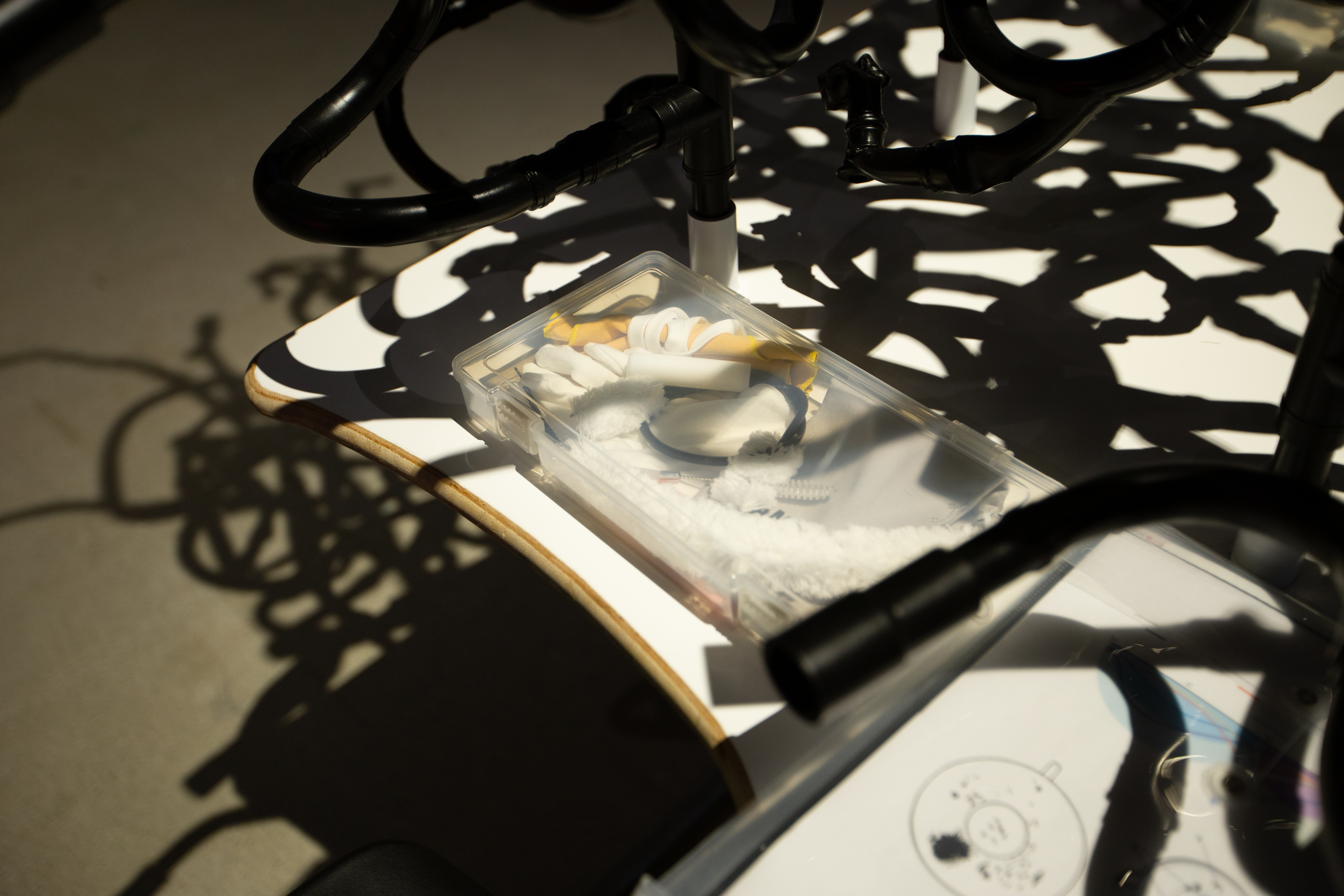
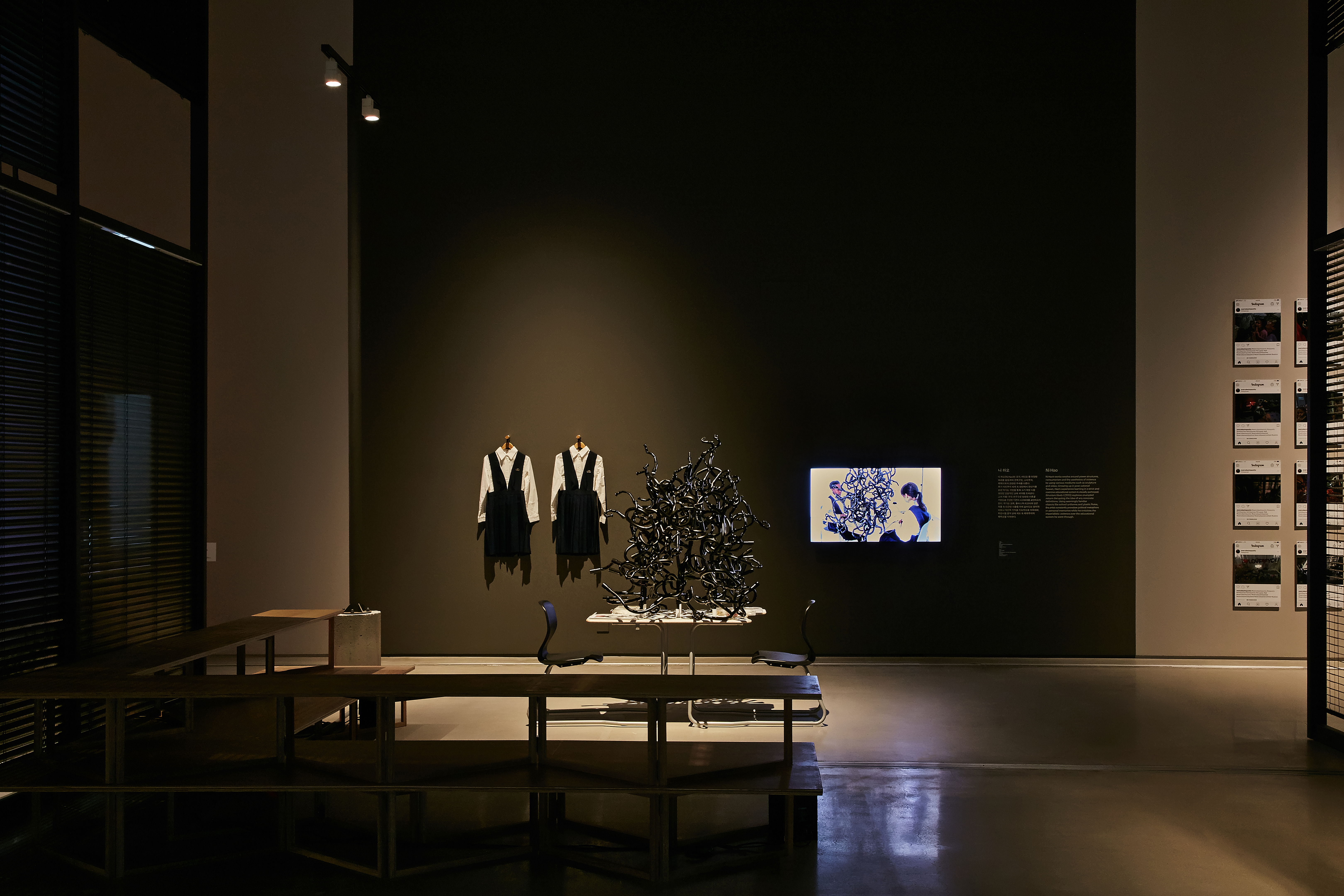
The collection installation includes the remade sculpture with numbered parts for reassembly, school uniforms, props, and the 2012 performance video.典藏的裝置包括以編號零件重新組裝的重製雕塑、學生制服、道具及 2012 年的表演錄像。
Performance (Version I), 2012
Sophia Sobers and Katie Taylor, Rhode Island School of Design, Providence
Performance duration 9 minutes表演(第一版),2012
演出:Sophia Sobers、Katie Taylor,普羅維登斯,羅德島設計學院
表演全長 9 分鐘
Performance (Version II), 2022
Lin Tzu-Ning 林子寧 and Yu Xin You 游育歆
Walking the Crack, Taipei Fine Arts Museum, curated by Fang-Wei Chang
Performance duration approximately 25 minutes
Sculpture on loan from the National Museum of Modern and Contemporary Art, Korea.表演(第二版),2022
演出:林子寧、游育歆
《在夾縫中行走》,臺北市立美術館,策展人張芳薇
表演全長約 25 分鐘
雕塑由韓國國立現代美術館出借。
For many people who grew up in Taiwan, including the artist, the sound of the plastic recorder is familiar from elementary school. In music class, children played Taiwanese folk songs and Western classics together. The recorder could make a roomful of children sound like one body. It could also make a sound closer to distress than music.
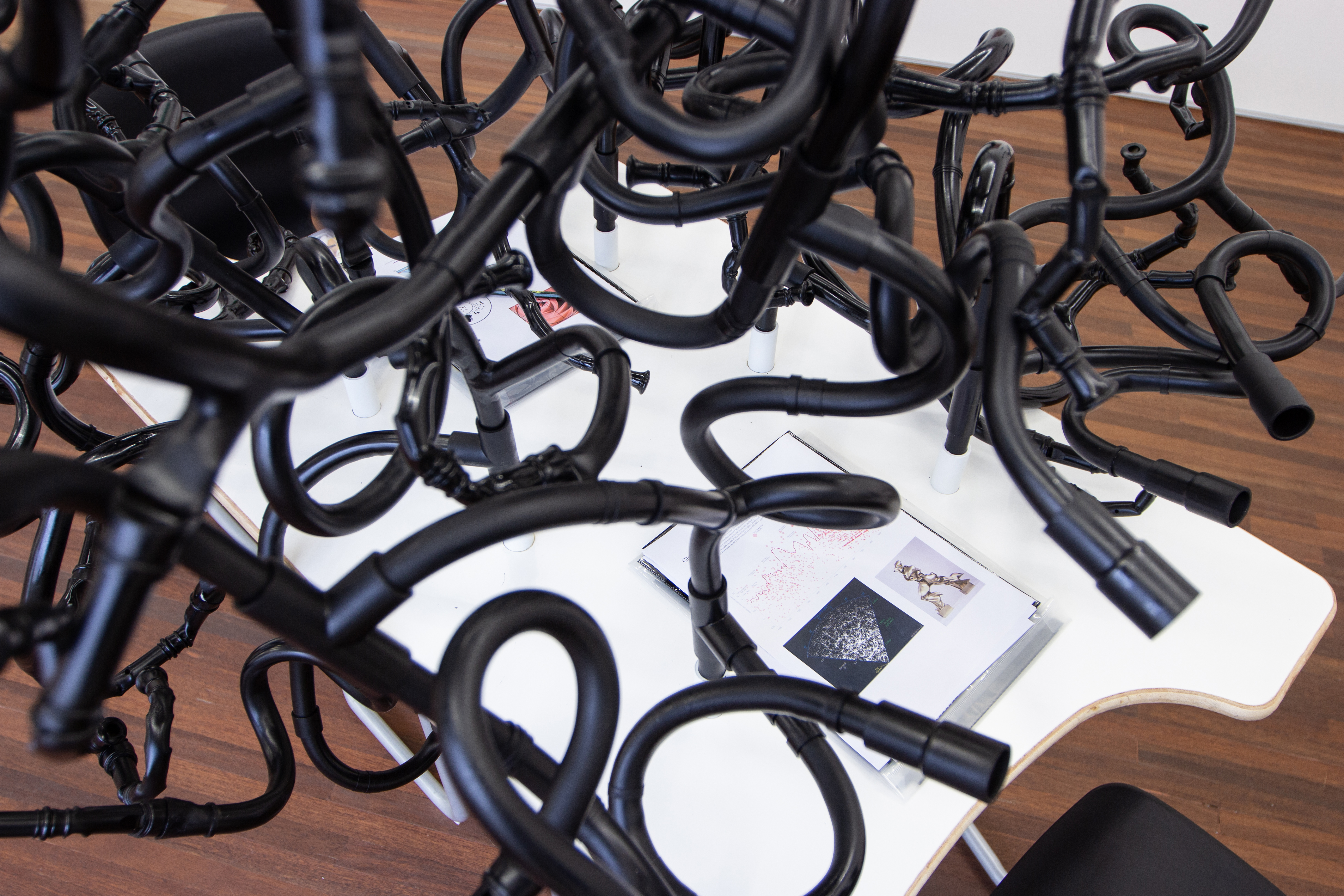
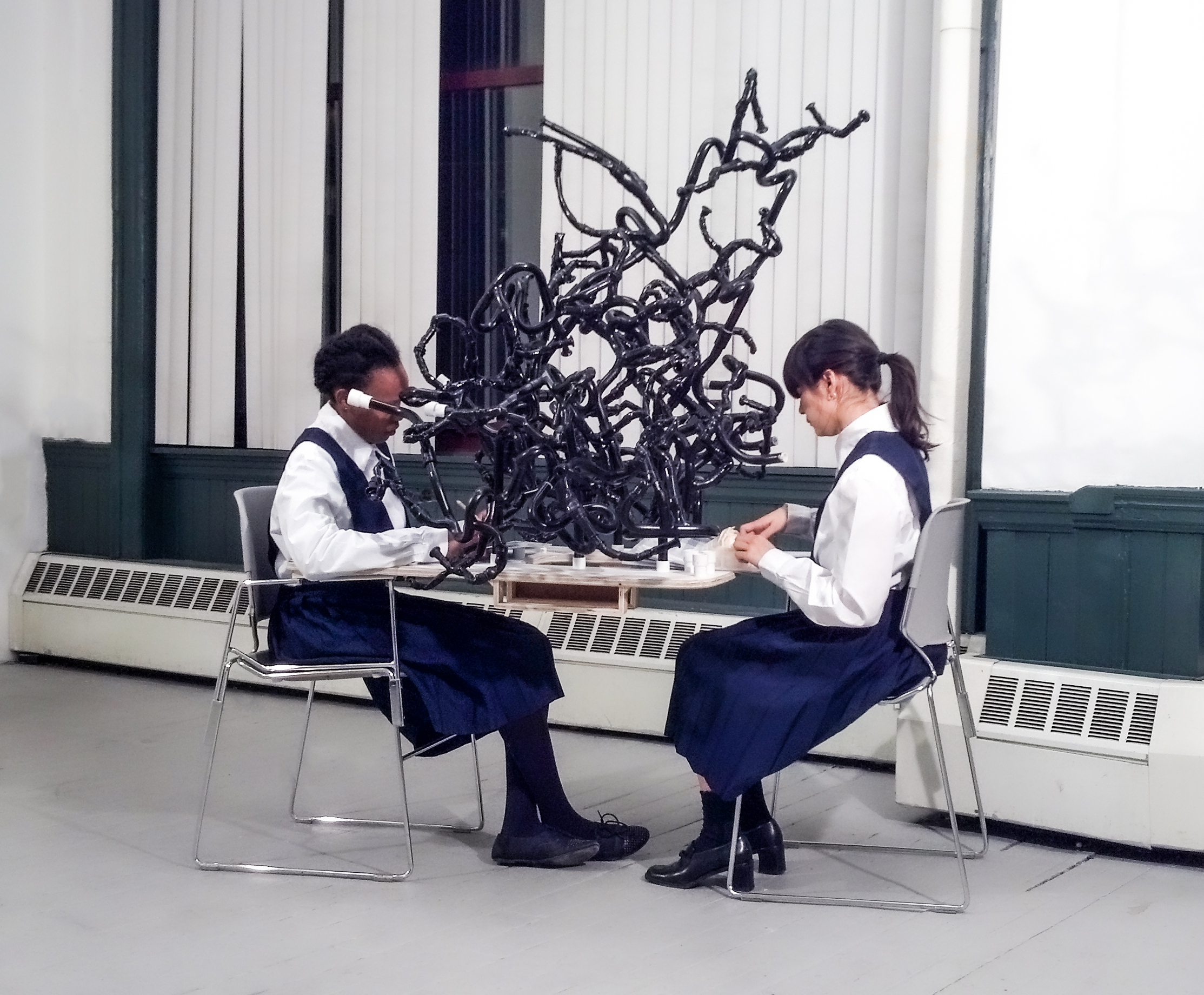
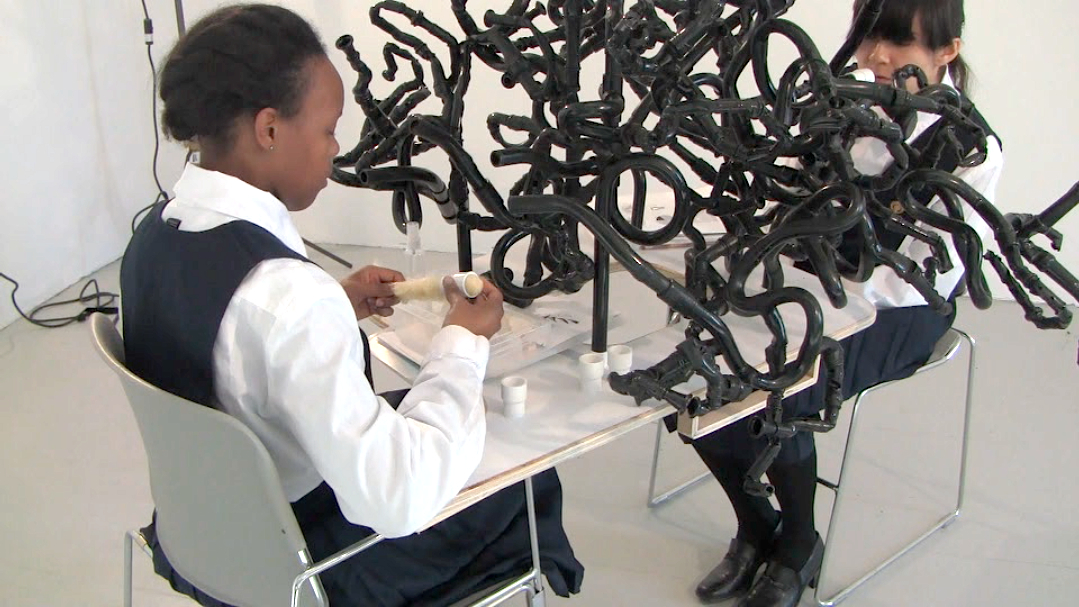
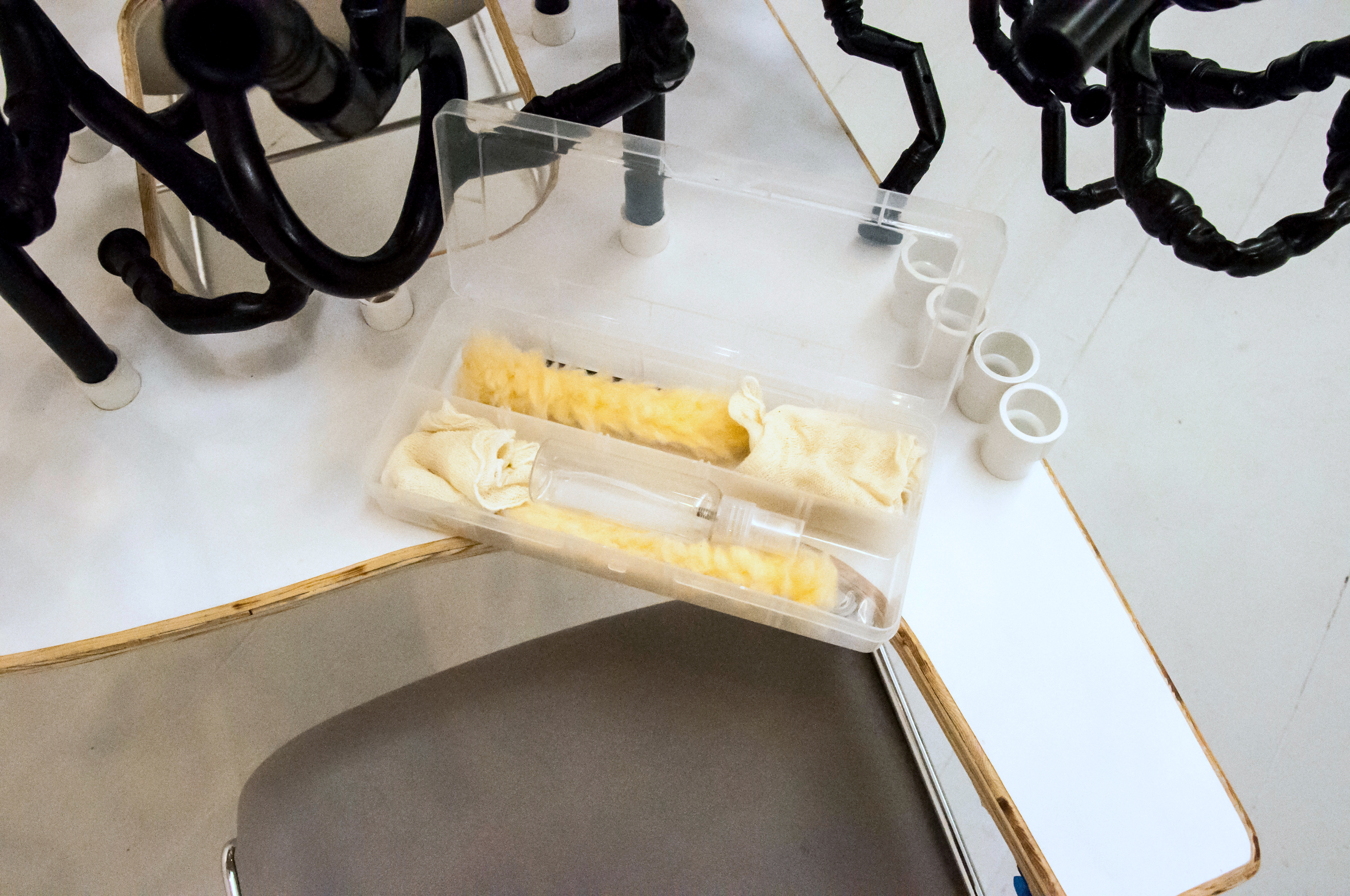
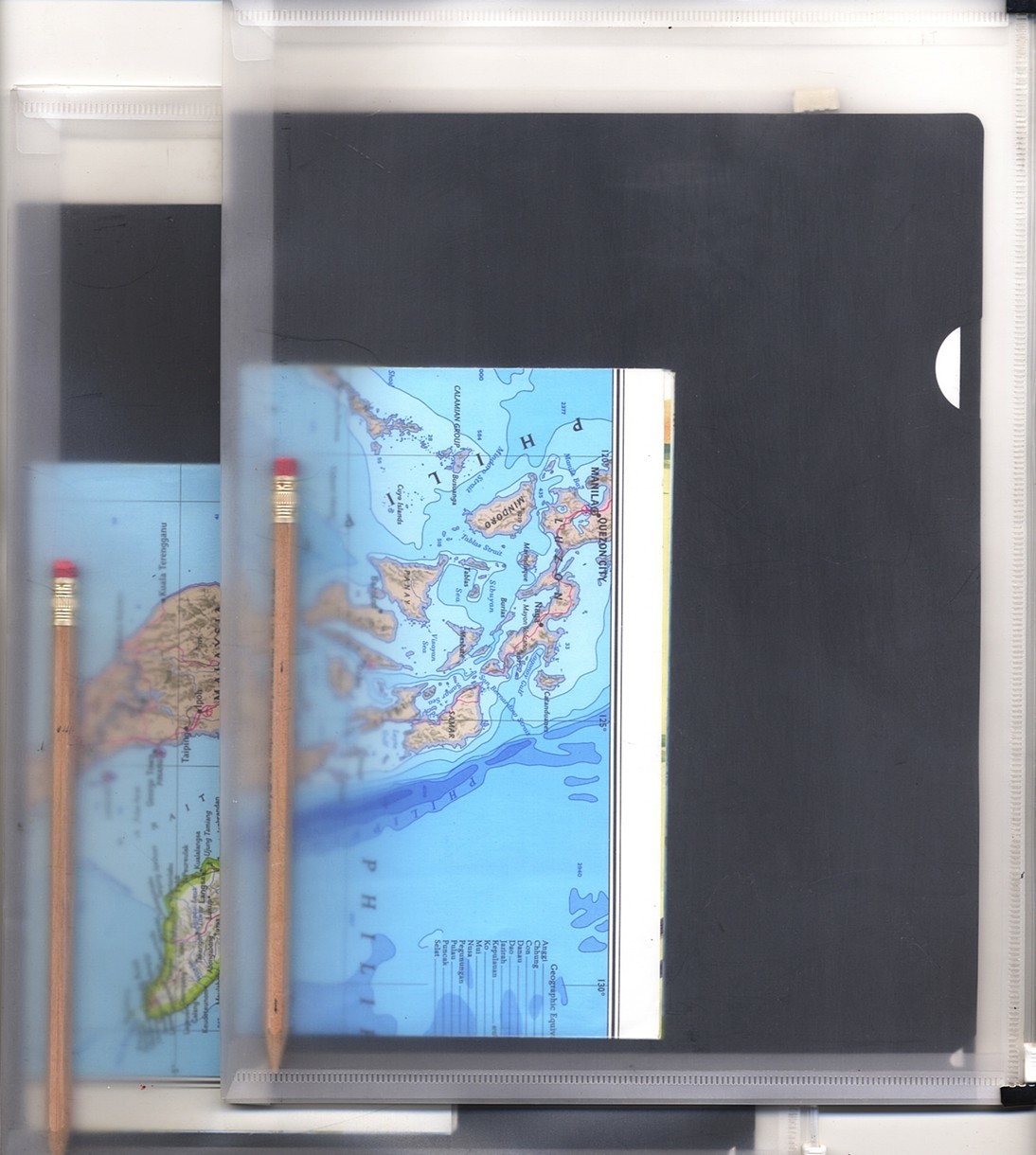
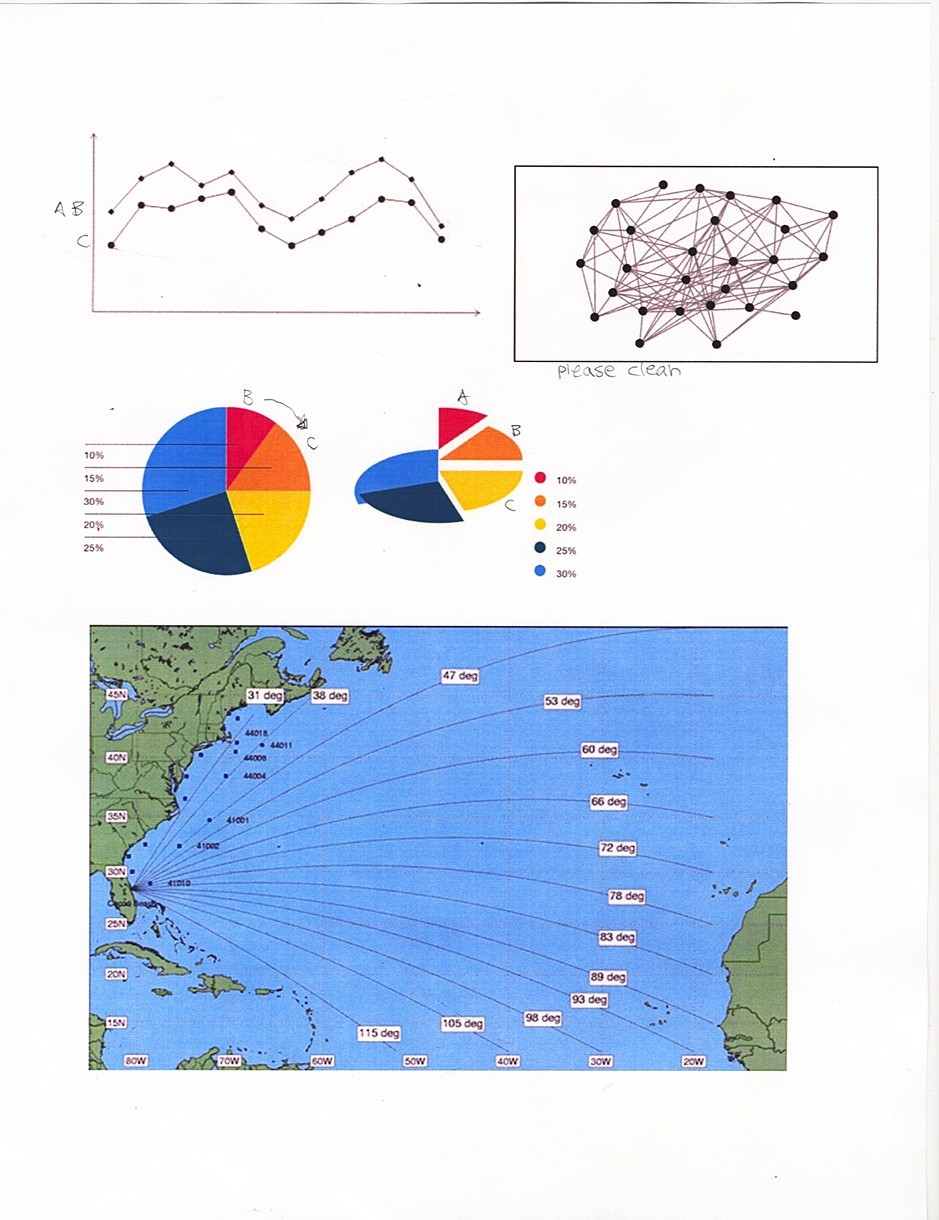
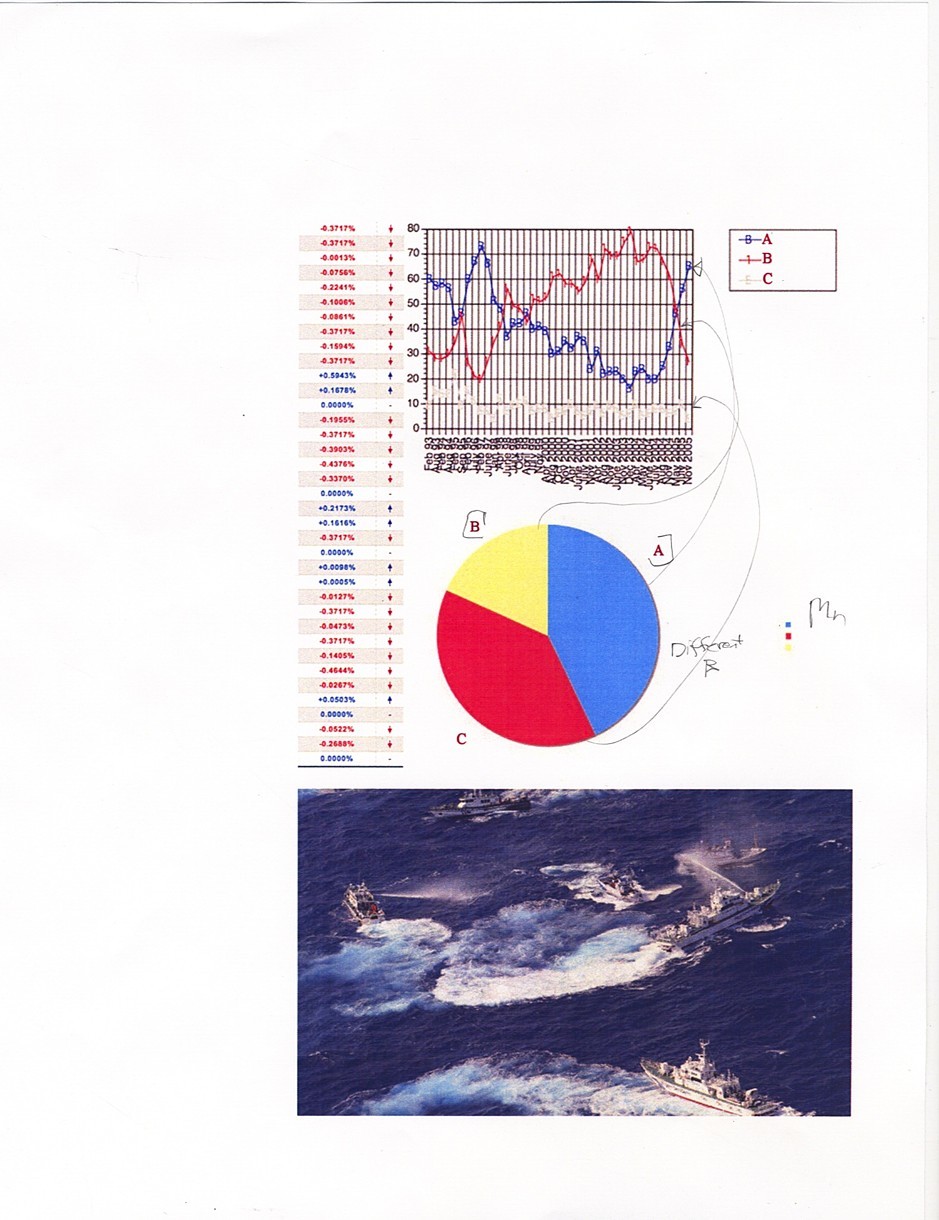
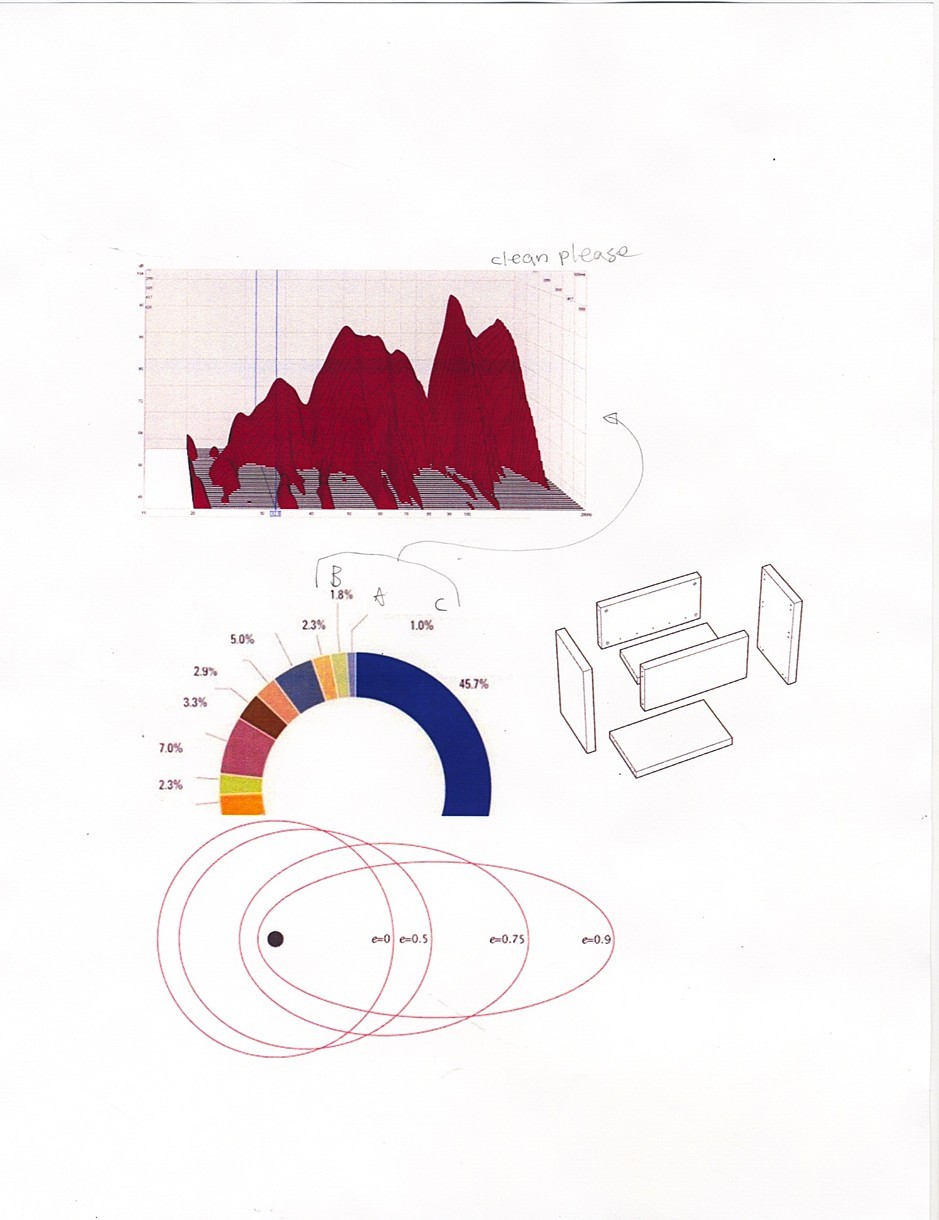
Structure Study I was first performed at a graduate critique at the Rhode Island School of Design in 2012. Two performers in school uniforms sit on either side of a black tangle of melted recorders and PVC pipes. Mouthpieces point in different directions. The performers take news images, pie charts and line graphs as scores, turn them into breath and sound, and close by briefly cleaning the instrument.
In Germany at the end of the 1920s, Peter Harlan’s inexpensive “people’s recorder” spread through the youth music movement. Its simplified fingering made a basic scale easier for beginners. Nazi propaganda pictured uniformed members of the League of German Girls playing it. In 1934 Carl Orff pressed his publisher for a booklet of recorder dances for the group. At the opening-day pageant of the 1936 Berlin Olympics, recorders from treble to bass sounded in the Güntherschule Youth Orchestra. Gunild Keetman composed the score from Orff’s sketches and conducted as children danced a round choreographed by Dorothee Günther and Maja Lex. In 1948 a copy of the Olympic record helped set in motion the school broadcasts that became the basis of Orff and Keetman’s Music for Children.
Yoshitaka Sakamoto recalled hearing members of the Hitler Youth play recorders at Wannsee. He returned to Japan in 1939 with three German recorders, which the maker Nikkan used as models. His 1943 method book used German fingering and put Japanese school songs alongside German folk songs and the Nazi Party anthem. In 1950, during the U.S.-led occupation, a recorder trio played at Japan’s Ministry of Education, and within months the recorder was chosen for the school curriculum. Nikkan began selling a plastic school recorder with German fingering in 1955. In 1970 it merged into the company now called Yamaha.
Taiwan’s 1975 elementary music standards listed the recorder from fourth grade, as Japan’s had in 1958. Under martial law, textbooks for that curriculum taught the Republic of China’s anthem and an anti-Communist song. Orff teaching had reached Taiwan through Salzburg-trained teachers and collaborations with Belgian educators. In 1983 Wang Shang-ren used Aulos recorders ordered from Japan in his Taipei Orff workshops. By 1993, recorder instruction was part of the required music curriculum in both elementary and junior high schools. That year’s elementary revision brought it into third grade. Later textbooks gave Taiwanese songs more space. The work follows a trace of fascism through the history of an instrument that also carried the sound of home.
In the 2022 performance at Taipei Fine Arts Museum, the choreography moves out from the two chairs. One performer stays at a mouthpiece while the other takes up sticks. They circle the sculpture, lower themselves to the floor and return to the table at different times. The movement draws on children’s stick exercises, including a formation that suggested a small temple, and on Maja Lex’s Ekstatischer Kreis and Ekstatischer Tanz, the latter with music by Keetman. The closing passage gives both performers time to put on gloves and clean the instrument together. The work holds on to how good it can feel to fall into time together, even when someone else has set the pace.對許多在臺灣長大的人來說,塑膠直笛是從小學就熟悉的聲音,藝術家也有這段記憶。音樂課上,孩子們一起吹奏臺灣民謠和西方經典曲目。直笛能讓一整間教室的孩子聽起來像同一具身體,也能發出近乎哀鳴的聲音。
《結構研究 I》於 2012 年在羅德島設計學院的研究所評圖中首次演出。兩位身穿制服的表演者分坐在一團由熔融直笛和 PVC 管交纏而成的黑色雕塑兩側,吹嘴朝向各個方向。他們把新聞影像、圓餅圖和折線圖當作樂譜,將圖像轉成呼吸與聲音,最後簡短地清潔樂器。
1920 年代末的德國,彼得・哈蘭(Peter Harlan)推出的平價「大眾直笛」隨青年音樂運動普及。簡化的指法讓初學者更容易吹出基本音階。納粹宣傳影像中,身穿制服的德國少女聯盟成員吹奏這種直笛。1934 年,卡爾・奧福(Carl Orff)催促出版商為該團體出版一本直笛舞曲小冊。1936 年柏林奧運開幕日的表演中,君特學校青年管弦樂團使用了從高音到低音的各種直笛。古尼爾德・凱特曼(Gunild Keetman)依奧福的草稿寫成樂譜並擔任指揮,孩子們則跳著由多蘿特・君特(Dorothee Günther)與瑪雅・萊克斯(Maja Lex)編排的圓舞。1948 年,這張奧運唱片促成了校園音樂廣播的籌備,節目後來成為奧福與凱特曼《兒童音樂》(Music for Children)的基礎。
坂本良隆回憶,自己曾在萬湖(Wannsee)聽見希特勒青年團成員吹奏直笛。1939 年,他帶著三支德國直笛回到日本,日本管樂器公司(日管,Nikkan)以它們為樣本。坂本於 1943 年出版的教本採用德式指法,收錄了日本學校歌曲、德國民謠與納粹黨黨歌。1950 年,在美國主導的占領期間,一組直笛三重奏在日本文部省演出,數月內直笛便獲選納入學校課程。1955 年,日管開始販售採德式指法的塑膠學校用直笛,並於 1970 年併入今日的山葉公司。
臺灣 1975 年的國小音樂課程標準從四年級列入直笛,日本 1958 年的課程標準亦然。戒嚴時期,依該標準編寫的教科書教授中華民國國歌與反共歌曲。奧福教學法經由在薩爾茲堡受訓的教師,以及與比利時教育者的合作,傳入臺灣。1983 年,王尚仁在臺北的奧福研習中使用向日本訂購的 Aulos 直笛。到了 1993 年,直笛已列入國小與國中的必修音樂課程。當年的國小課程標準修訂將直笛教學提早至三年級。此後,臺灣歌謠在教科書中有了更多篇幅。作品循著這件樂器的歷史,追索法西斯主義留下的痕跡。這件樂器也承載過家鄉的聲音。
2022 年在臺北市立美術館的演出中,動作從兩張椅子向外展開。一位表演者仍在吹奏,另一位拿起短棒。他們繞著雕塑移動,伏低身體至地面,再先後回到桌邊。動作取材自兒童的持棒練習,包括一個讓人聯想到小廟的隊形,也參考了瑪雅・萊克斯的《狂喜之環》(Ekstatischer Kreis)與《狂喜之舞》(Ekstatischer Tanz),後者由凱特曼作曲。演出尾聲留出時間,讓兩人戴上手套,一起清潔樂器。作品保留了與他人合拍的愉悅,即使節奏是由別人定下的。
Einzug und Reigen der Kinder (Entrance and Round Dance of the Children), music for the opening-day pageant of the 1936 Berlin Olympics. Güntherschule Youth Orchestra, conducted by Gunild Keetman. Telefunken E 2032, issued in 1936. Listen to the recording
Selected research
Orff’s 1934 proposal · Keetman’s Olympic score · The recorder in Japan · Recorder education in Taiwan · Orff teaching in Taiwan〈Einzug und Reigen der Kinder〉(兒童進場與圓舞),為 1936 年柏林奧運開幕日表演所作。君特學校青年管弦樂團演奏,古尼爾德・凱特曼指揮。Telefunken E 2032,1936 年發行。聆聽錄音
部分研究資料
奧福 1934 年的提案 · 凱特曼的奧運樂譜 · 日本的直笛發展 · 臺灣的直笛教育 · 臺灣的奧福教學